
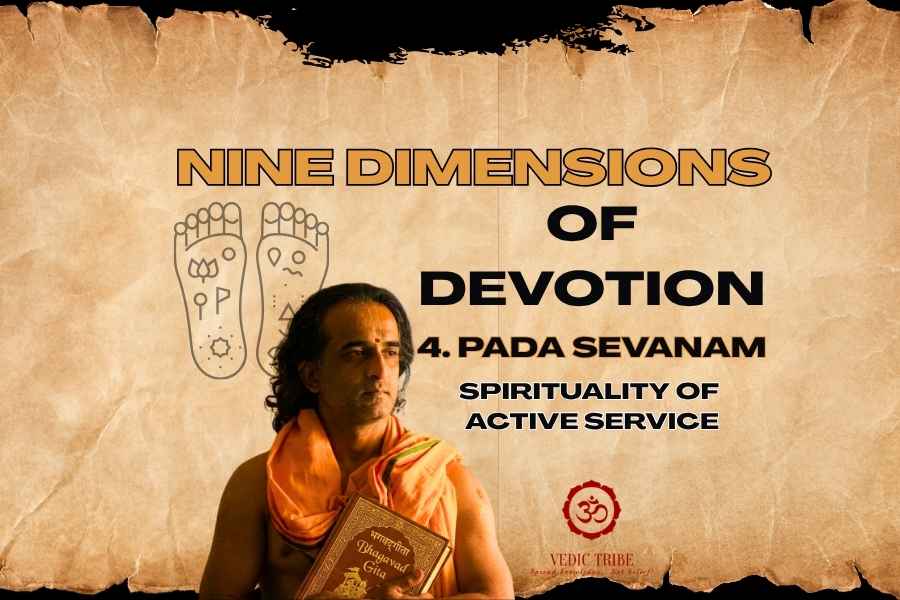
Having journeyed through Shravana (listening to wisdom), Kirtana (vocalizing truth), and Smarana (internal contemplation), we reach the vital turning point where inner devotion transforms into tangible outer action: Pada Sevana (पादसेवन)—the fourth dimension of Navadha Bhakti.
In a culture that often views spirituality as an abstract, solitary pursuit or an escape from worldly duties, Pada Sevana stands as a powerful reminder that Indian spiritual tradition is fundamentally a practical spirituality. It bridges the gap between deep contemplation and active, compassionate engagement with the world around us.
What is Pada Sevana?
The Sanskrit term पादसेवन (Pada Sevana) literally translates to “serving the sacred feet.”
While in a traditional or temple context this refers to physically serving the deity, the Bhagavata and Vedic traditions offer a much broader, cosmic interpretation:
- The Feet as Creation: The cosmos, nature, humanity, and all living beings are considered the physical manifestation—the “feet”—of the Supreme Being (Virat Purusha).
- Selfless Service: Therefore, Pada Sevana means serving society, protecting nature, helping those in need, and executing our daily duties with the mindset that we are serving the Divine embedded in creation.
If Smarana anchors the mind in God, Pada Sevana engages the hands and body in God’s work.
Why Pada Sevana is Essential in the Modern World?
In an age dominated by individualism, transactional relationships, and systemic burnout, Pada Sevana provides an essential shift in perspective:
- Dissolving Ego through Action: When we serve others without expecting praise or personal reward, the toxic demands of the ego (Ahamkara) begin to dissolve. We stop asking, “What’s in it for me?” and start asking, “How can I contribute?”
- Transforming Daily Duty into Worship: Pada Sevana teaches us that spiritual life does not require abandoning our professions or families. Whether you are an entrepreneur, engineer, teacher, healthcare worker, or homemaker, performing your duty with integrity, care, and compassion is direct Pada Sevana.
- Restoring Harmony with Nature & Society: Honoring the “feet” of the Supreme means respecting ecological balance, practicing sustainability, and fostering social welfare. It makes spirituality socially relevant and environmentally conscious.
Forms of Pada Sevana Practice
Depending on your life stage and circumstances, Pada Sevana can take many forms:
- Seva (Selfless Community Service): Volunteering time, expertise, or resources to uplift the underprivileged, feed the hungry, or support educational causes.
- Environmental Stewardship: Caring for animals, planting trees, and conserving natural resources as acts of reverence toward mother earth.
- Excellence in Professional Work: Treating work responsibilities not merely as a job for income, but as a sacred service to society and the Almighty.
- Temple and Sacred Space Care: Maintaining cleanliness, order, and dignity in places of worship and community gathering.
Exemplars of Pada Sevana
In sacred tradition, Goddess Lakshmi is depicted as continuously engaged in Pada Sevana at the feet of Lord Narayana—not out of obligation, but as an expression of infinite love, humility, and harmony. Similarly, figures like Bharata served the sandals (Padukas) of Shri Rama, governing the kingdom selflessly with the conviction that he was merely a custodian serving the higher divine order.
Practical Ways to Cultivate Pada Sevana Today
- Daily Micro-Seva: Perform at least one act of selfless kindness every day without making a noise about it—help a neighbor, mentor a junior colleague, or feed a stray animal.
- Work as Service: Before starting your workday, set an intention: “May my efforts today bring value, relief, and benefit to others.”
- Eco-Conscious Living: Reduce waste and respect physical surroundings, viewing cleanliness and nature conservation as spiritual disciplines.
What Comes Next?
Shravana fills our heart with wisdom, Kirtana gives it expression, Smarana establishes inner focus, and Pada Sevana expresses that love through humble service. Once our actions are purified through service, we naturally progress to formal, structured worship: Archana (अर्चन)—the Fifth Dimension of Devotion.
At Vedic Tribe, we invite you to practice Pada Sevana this week. Look around you, identify where service is needed, and let your hands perform what your heart contemplates.
In our next article, we will explore Archana (The Science and Ritual of Sacred Worship)—how structured Vedic rituals cultivate order, focus, and spiritual discipline.
Madhwesh K
Vedic Tribe