
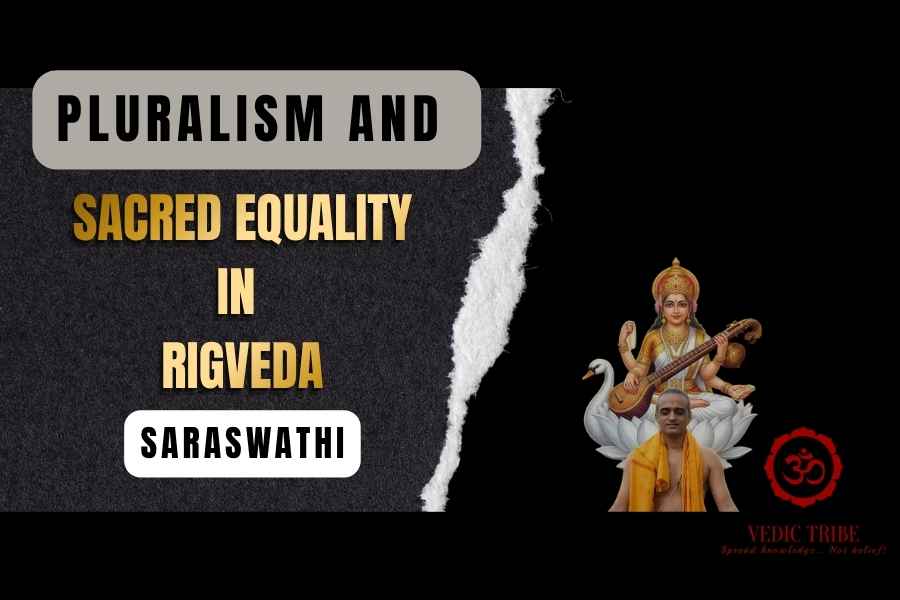
Following our exploration of Lakshmi as the cosmic light of auspicious fortune, we turn to the second divine feminine principle in our Vedic series: Saraswati (सरस्वती).
While popular modern iconology recognizes Saraswati primarily as the goddess of learning, arts, and music sitting with a Veena, her Vedic roots run far deeper into the fabric of cosmic order and human consciousness.
In the Rigveda, Saraswati is both the divine stream of truth-consciousness and the physical lifeline of ancient Indian civilization.
Saraswati in the Rigveda: Divine Speech and Truth in Action
In the Vedic context, Saraswati represents Vac (वाच्)—the sacred, illuminating speech that brings clarity to the human intellect.
The 61st Sukta of the 6th Mandala of the Rigveda is entirely dedicated to Saraswati, praising her as a formidable, purifying power who shatters ignorance and illuminates the minds of seekers.
In his mystical commentary on Vedic symbolism, Sri Aurobindo offers a profound interpretation of her core nature:
- Drawing from hymns like the 110th Sukta of the 10th Mandala of the Rigveda, he explains that Saraswati represents the divine inspiration flowing directly from Rtam (ऋतम्)—the absolute Truth in action.
- She is not merely passive intellectual knowledge; she is the dynamic, flowing intuition that connects human thought with cosmic order.
The Cosmic Symphony: Brahmana, Epic, and Upanishadic Insights
The understanding of Saraswati matured across the Vedic and post-Vedic corpus, establishing her role in governing cosmic harmony:
- Taittiriya Brahmana (Krishna-Yajurveda): Explicitly identifies Saraswati with Speech (Vac) and Music (Gandharva), framing sound as the creative force of the universe.
- Mahabharata: Reveres Saraswati as the goddess of the primordial symphony—the underlying resonance that maintains order across cosmic affairs.
- Devi Upanishad: Presents Saraswati as one of the principal, exalted forms of Devi / Shakti, the supreme power through which the cosmos is perceived and known.
- Puranic Tradition: She is recognized as the consort of Virinchi (Brahma)—the primeval creator consciousness within this universe—symbolizing that creation cannot manifest without creative knowledge and expression.
The Divine Feminine Trinities
Throughout the Vedic and Puranic literature, Saraswati appears as an indispensable pillar in sacred feminine triads:
- The Vedic Triad: Ila – Saraswati – Bharati (representing intuition, inspiration, and divine revelation).
- The Classical Triad: Lakshmi – Saraswati – Parvati (embodying wealth/sustenance, wisdom/creation, and power/dissolution).
- The Esoteric Tantric Triad: Mahalakshmi – Mahasaraswati – Mahakali.
These recurring triads highlight that in native Indian thought, divine functions were always understood as interconnected, pluralistic feminine forces.
The Sacred River: Debunking Colonial Historiography
Beyond her metaphysical aspect, Saraswati is the ancient, mighty river of the Indian subcontinent that dominates the geography of the Rigveda. The scripture describes her as Nadtitama—the greatest of all rivers—flowing gracefully from the snow-capped Himalayas to the Arabian Sea.
In modern historical and archaeological research, the study of the Saraswati River has played a pivotal role:
- Indigenist Framework: Hydrological and satellite imaging confirm the drying up of this massive river around 1900 BCE, placing the core Rigvedic period well before this desiccation.
- Debunking the Invasion/Migration Theory: The central presence of the Saraswati River in Vedic texts directly links the Vedic people with the native Harappan/Sindhu-Saraswati civilization, dismantling the colonial “Aryan Invasion / Migration Theory” that sought to frame Vedic culture as an external import.
For those keen on exploring the scientific and historical evidence surrounding this sacred river, the research paper “Rigvedic Saraswati: Myth and Reality” by Ashoke Mukherjee (published in the journal of Breakthrough Science Society, Vol. 9, No. 1, Jan 2001) provides a detailed overview.
What Comes Next?
Saraswati teaches us that true wisdom is not static information, but a flowing stream of inspired truth that purifies our thoughts, speech, and actions.
In our next and final article of this series, we will examine the third divine feminine principle: Bharati—the companion of Prana and the radiant goddess of divine revelation and spiritual illumination.
Stay connected with Vedic Tribe as we continue to reclaim and celebrate our authentic Vedic heritage!
In the next write-up we will discuss “Bharati”.
Madhwesh K
Vedic Tribe