
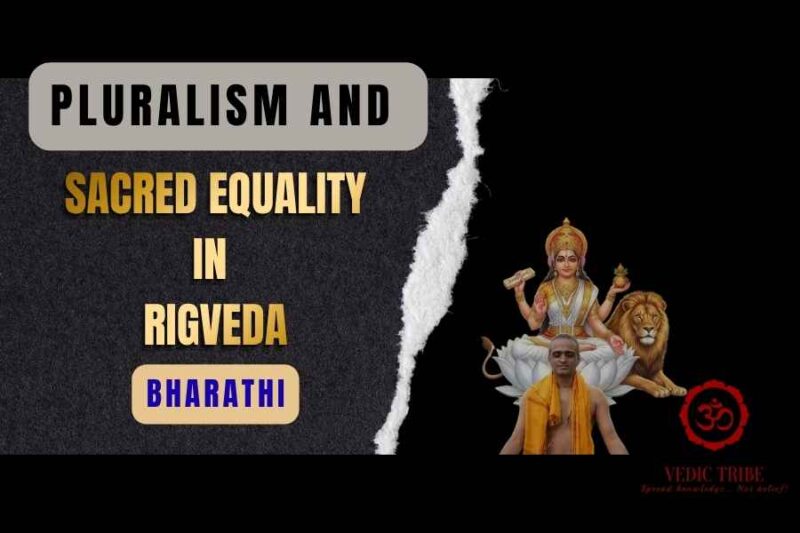
Having explored Lakshmi (the cosmic light of auspicious fortune) and Saraswati (the eternal river of truth and inspiration), we conclude our series on divine femininity in the Rigveda with the third exalted principle: Bharati (भारती).
While the name Bharati is widely recognized today in connection with Bharat Mata (Mother India) or as an epithet for speech and learning, her original Vedic roots reveal a magnificent metaphysical reality: Bharati as the goddess of divine light, spiritual illumination, and eternal bliss.
The Triad of Divine Revelation
The Sanskrit term भारती (Bharati) derives from the root bhr (भृ), meaning “to carry, sustain, or shine.” Etymologically, it signifies one who is deeply indulged in the light of divine bliss (Bha).
In the sacred hymns of the Rigveda—particularly in the ritual hymns of invocation—Bharati appears as an indispensable member of the Vedic feminine trinity: IlaBharatiSaraswati
Within this sacred triad, each goddess governs a distinct level of spiritual perception:
- Ila: Represents the power of divine vision and intuition (Drishti).
- Saraswati: Represents the power of divine inspiration and inner hearing (Sruti).
- Bharati (also called Mahi): Represents the vast, luminous power of divine revelation and cosmic expansion (Bharati).
Together, these three goddesses act as the inner faculties through which human consciousness receives higher truth.
Consort of Prana
While the names Lakshmi and Saraswati are sometimes used epithetically as Bharati in broader Vedic passages, in the precise order of divine consciousness, Bharati is the eternal consort of Prana (Mukhya Prana)—the highest, most vital conscious principle operating within creation.
Just as Prana is the cosmic life force that animates all physical and mental functions, Bharati is the guiding, luminous energy that turns vital life into spiritual bliss.
The Madhva Tradition and the Avatar of Draupadi
The metaphysical role of Goddess Bharati is uniquely preserved and illuminated in the Tattvavada (Dvaita) philosophy established by Sri Madhwacharya.
In his foundational work, the Mahabharata Tatparya Nirnaya (drawing from canonical sources like the Narada Purana and Vayu Purana), Sri Madhwacharya clarifies the composite avataric nature of Draupadi in the Mahabharata.
Draupadi was not an ordinary mortal; she was the earthly manifestation of a hierarchy of divine feminine principles led primarily by Goddess Bharati (as the consort of Prana/Bheema), alongside Shyamala (consort of Dharma), Shachi (consort of Indra), and Usha (consort of the Ashwins).
Because of her exalted status as the presiding deity of vital energy and devotion alongside Mukhya Prana, prayers and salutations to Goddess Bharati form an essential, indispensable part of daily ritual worship (Nitya Puja) within the Madhva tradition to this day.
Cultural Evolution: From Vedic Goddess to Bharat Mata
In contemporary Indian lore, the ancient name Bharati seamlessly bridges our spiritual past with our national consciousness. Bharata-mata (Mother India)—the personification of the sacred land—is directly associated with Goddess Bharati.
This is not a modern political invention, but the natural continuation of a Vedic worldview that sees the physical earth, geography, and culture as sacred physical manifestations of divine feminine energy.
For readers seeking a deeper academic and cultural understanding of how river systems, landmasses, and divinity intersect in native thought, the book “River and Goddess Worship in India” by R.U.S. Prasad provides an insightful study.
Defending Our Vedic Heritage
With Bharati, our introductory series on the three chosen divine feminine principles of the Rigveda comes to a fulfilling close.
From Lakshmi (the light of auspicious truth) to Saraswati (the stream of inspired wisdom) and Bharati (the bliss of divine illumination), the Rigveda proves beyond doubt that the divine feminine was never secondary, subordinate, or oppressed in authentic Indian tradition. It was, and remains, co-equal, essential, and supreme.
At Vedic Tribe, our goal is to inspire you to look beyond borrowed colonial biases and medieval distortions. By reading, studying, and understanding our scriptures directly, we empower ourselves to celebrate and defend the timeless, pluralistic glory of our heritage.
Thank you for following this series. Continue to study, question, and adopt our practical spiritual tradition in your daily life!
All the best
Madhwesh K
Vedic Tribe