
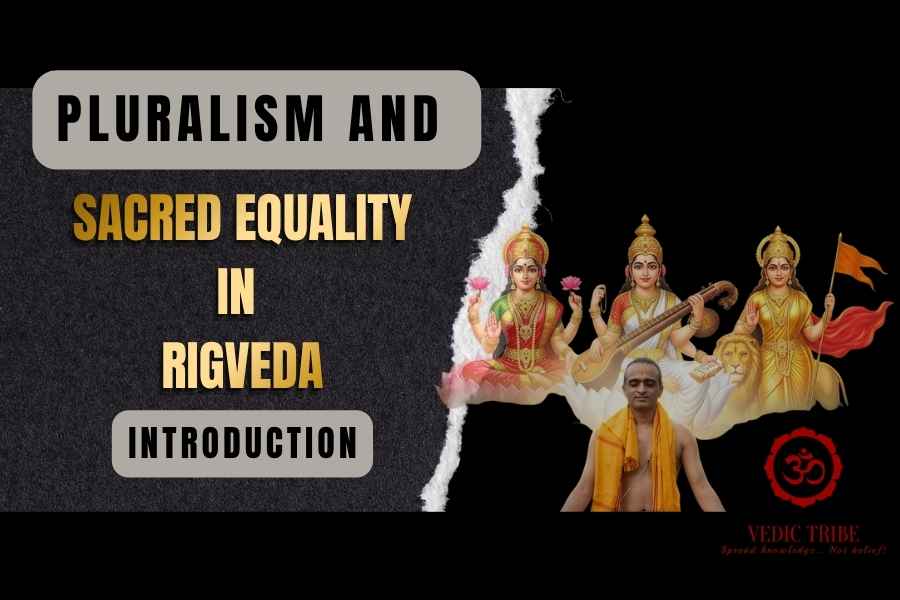
In the foundational worldview of the Vedic rishis, divinity was never imagined as a singular, monolithic male authority residing in a distant sky.
Instead, the universe was understood as an intricate, harmonious play of complementary forces—where the divine masculine (Deva) and the divine feminine (Devi) exist as co-equal aspects of one Supreme Reality.
Far from being a later development or a subordinate concept, the Divine Feminine is woven into the very fabric of the Rigveda, the foundational text of our spiritual tradition.
Yet, modern narratives often obscure this profound heritage.
At Vedic Tribe, we present this introductory series exploring three prominent manifestations of divine femininity in the Rigveda—Lakshmi, Saraswati, and Bharati—and examine how a deeper reading of our scriptures dismantles both medieval social shifts and biased academic narratives.
Cosmic Equilibrium and Pair Worship
In the Vedic tradition, cosmic functions are governed through paired principles.
Creation, protection, illumination, and vital movement require both an initiating force and an organizing, nurturing power:
- Prakriti and Purusha: Form and consciousness.
- Vac and Prana: Sacred utterance and vital breath.
- Deva and Devi: Worshiped together because cosmic order (Rta) cannot function through one without the other.
Classical literature and ancient ritual manuals (Kalpa Sutras) reflect a native society that embraced these pluralist ideals naturally.
Women participated as Brahmavadinis (scholars of sacred knowledge), composed Vedic hymns, and performed essential roles in sacred rituals alongside men.
The Shift Toward Protectionism
If equality was the foundational Vedic baseline, why did later Indian society exhibit strong patriarchal constraints?
To understand this shift, one must analyze historical social dynamics. Over centuries, native Indian society faced successive waves of foreign invasions—including Turkish and Mughal conquests. In response to widespread destruction, economic plunder, and the violation of domestic security, the social structure underwent a profound defensive transformation:
- Rise of Protectionist Systems: Communities turned inward, constructing rigid, protective social walls to safeguard women, families, and cultural practices from external threat.
- Submergence of Public Feminine Agency: As security became the overriding social priority, patriarchal structures gained heavy traction out of protective necessity rather than theological mandate.
- Shift in Narrative: Post-classical literature and regional social codes gradually reflected this protectionist reaction, causing the public, equal role of the divine feminine to recede into the domestic and private spheres.
Dismantling Western Academic Bias
Regrettably, modern academia often misinterprets this historical evolution. Western Indologists—most notably scholars like Wendy Doniger (author of The Hindus: An Alternative History)—have frequently projected Western socio-political frameworks onto ancient Indian texts. They construct a narrative asserting that the Vedic tradition itself was inherently, systematically, and institutionally patriarchal and oppressive toward women.
This perspective suffers from two fatal flaws:
- It conveniently ignores the external historical catalyst—the severe social disruption caused by centuries of invasive violence that forced society into a defensive posture.
- It conflates medieval social defense mechanisms with original Vedic theology.
Tragically, generations of post-independence Indian scholars adopted these Western orientalist lenses, allowing an inaccurate, skewed perception of Vedic culture to dominate mainstream Indian academia.
However, when one approaches the Rigveda directly—unburdened by colonial or ideological bias—an entirely different picture emerges: a tradition rich in pluralism, deep reverence for the feminine, and an unshakeable philosophy of mutual cosmic respect.
Preview of the Series: Three Divine Feminine Principles in the Rigveda
To illuminate the true standing of the divine feminine in our oldest scripture, Vedic Tribe will explore three exalted forms in this series:
- Lakshmi (Companion of Vishnu): Beyond material wealth, Lakshmi in the Vedic context represents Shri—the auspicious, organizing, and nourishing abundance that sustains cosmic order and divine purpose.
- Saraswati (Companion of Virinchi / Brahma): The eternal river of consciousness, speech (Vac), wisdom, and creative intuition who flows through the intellect of the seeker.
- Bharati (Companion of Prana): The radiant goddess of spiritual illumination and divine utterance, closely associated with the vital life force (Prana) that activates human potential and higher thought.
Our Intent: Reclaiming Our Intellectual Heritage
Our goal at Vedic Tribe is not merely to recount ancient lore, but to awaken curiosity and intellectual rigor. We invite you to study the Vedic literature firsthand—to understand its original language, philosophy, and context.
By grounding ourselves in genuine textual knowledge, we can confidently defend our sacred heritage against distorted mainstream narratives and rediscover a timeless, practical philosophy that honors both the masculine and feminine aspects of existence.
Stay tuned for our next article, where we will dive deep into the first divine feminine principle: Lakshmi—The Cosmic Power of Auspicious Abundance.
All the best
Madhwesh K
Vedic Tribe