
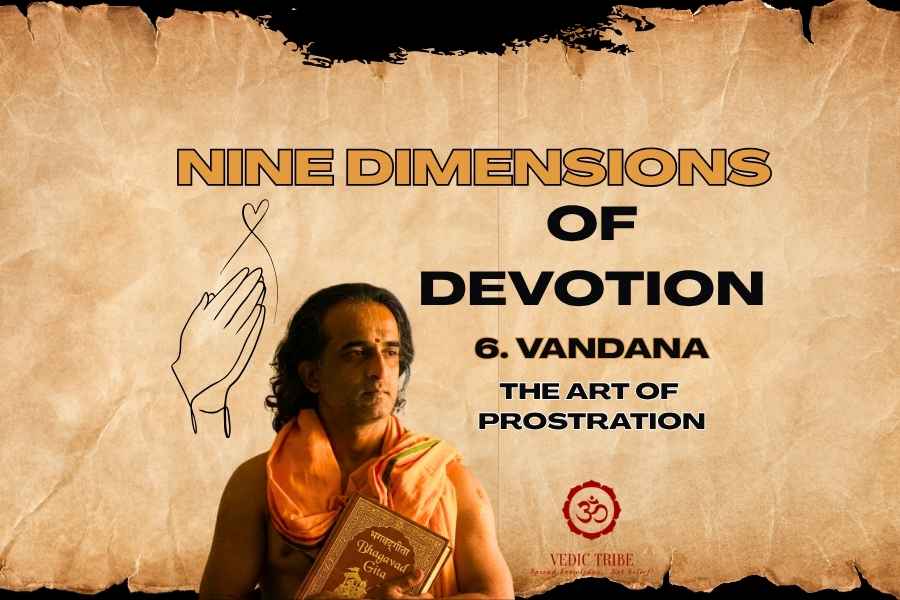
Having explored Shravana (listening), Kirtana (chanting), Smarana (contemplation), Pada Sevana (service), and Archana (structured worship), we arrive at the profound physical and psychological act of surrender: Vandana (वंदन)—the sixth dimension of Navadha Bhakti.
In a competitive modern culture that constantly promotes individual ego, self-importance, and pride, Vandana stands as a revolutionary, healing practice. Far from being a sign of weakness, this act of bowing down is a tool of practical spirituality that frees us from the heavy burden of the ego and restores internal balance.
What is Vandana?
The Sanskrit term वंदन (Vandana) comes from the root vand (वन्द्), which means “to bow down, salute, pay homage, or venerate.”
In the Bhagavata tradition, Vandana is the humble act of prostrating mentally and physically before the Supreme Consciousness, spiritual guides (gurus), elders, and the divine presence residing within all living beings.
If Archana is the external offering of materials, Vandana is the offering of oneself. It is the conscious recognition that we are small parts of a vast, intelligent universe.
The Psychology and Physiology of Vandana
Bowing down might seem like a simple physical posture, but its psychological and physical impacts are profound:
- Dissolving Ego and Stress: The human ego (Ahamkara) thrives on stiffness, pride, and defensiveness—attitudes that generate constant mental tension. Physically bowing down lowers the head below the heart, symbolically declaring that love and humility override intellect and pride.
- Nervous System Reset: Practices like Sashtanga Namaskara (eight-fold prostration) involve full-body contact with the earth. Modern science recognizes grounding techniques and posture shifts as effective ways to calm the sympathetic nervous system and reduce anxiety.
- Cultivating Receptivity: A cup must be placed lower than the teapot to be filled. Similarly, Vandana places us in a state of inner openness, allowing higher wisdom, grace, and peace to enter our consciousness.
Vandana demonstrates how Indian spiritual practices use physical body mechanics to transform internal mental states.
Forms of Vandana Practice
Depending on capacity, setting, and tradition, Vandana manifests in several ways:
- Sashtanga Namaskara (Eight-Limbed Prostration): Lying flat on the ground so that eight points of the body—feet, knees, chest, hands, shoulders, mind, speech, and sight—touch the earth in total surrender.
- Panchanga Namaskara (Five-Limbed Bow): Kneeling and touching the forehead, forearms, and knees to the floor—a common practice during daily prayer.
- Anjali Mudra & Head Bow: Joining palms together at the heart center (Namaste) and bowing the head slightly—honoring the divine spark within another person or sacred space.
- Manasa Vandana (Mental Prostration): Inwardly bowing down with deep gratitude when physical prostration is not possible.
Practical Ways to Integrate Vandana into Daily Life
You don’t need to be in a temple to practice the spirit of Vandana. Here is how you can practice it in modern settings:
- Morning Grounding: Start your day by bowing down briefly near your bed or prayer space, offering gratitude for a new day of life before reaching for your phone.
- Practicing Namaste with Intent: When greeting elders, family members, or colleagues, perform the gesture with genuine reverence rather than as an automatic habit.
- Bowing Before Learning: Bow mentally before reading sacred books, starting a study session, or beginning work, acknowledging that all knowledge flows from a higher source.
Exemplar of Vandana
In sacred tradition, Akrura—a noble minister sent to invite Shri Krishna to Mathura—is celebrated as the supreme master of Vandana. As Akrura approached the dust of Vrindavan, he was overwhelmed with emotion, jumped down from his chariot, and rolled in the sacred earth, prostrating again and again. His complete lack of self-consciousness or pride granted him immediate spiritual realization.
What Comes Next?
Vandana melts away the barriers of pride and arrogance. Once the ego is softened through humble prostration, a deep, active relationship develops between the seeker and the Divine: Dasya (दास्य)—the attitude of devoted alignment and service.
At Vedic Tribe, we invite you to practice Vandana this week. Bow your head in gratitude, release the stress of needing to control everything, and feel the lightness that follows.
In our next article, we will explore Dasya (Aligning Personal Will with Divine Will)—how viewing oneself as an instrument of a higher purpose brings ultimate strength.
Madhwesh K
Vedic Tribe